
Anti-Messi, Argentina sentiment surges after World Cup final loss
- Breaking News Foreign Front Page News Politics Sport
Demola Abimboye
- 0
- 6 minutes read
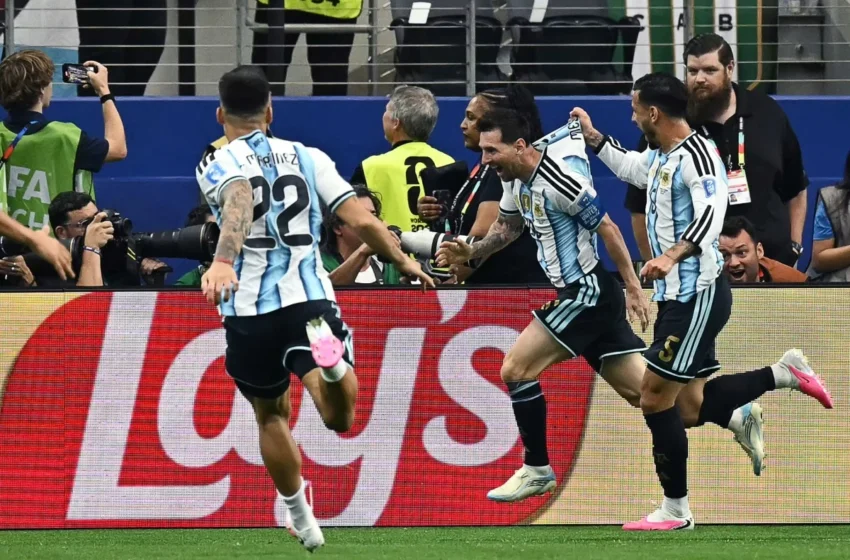
Messi (2nd R) celebrates with teammates after scoring his team’s second goal during the 2026 World Cup Group J football match between Argentina and Austria at the Dallas Stadium in Arlington on June 22, 2026. (Photo by Paul ELLIS / AFP)
By Saheed Oyelakin
A wave of anti-Messi and Argentina sentiment has spread across social media and parts of Europe and Latin America following Argentina’s defeat to Spain in the 2026 FIFA World Cup final, with reports of online abuse, xenophobic attacks and accusations of racism targeting Argentines.
Argentine newspaper, La Nacion, reported on Wednesday that many Argentines living or travelling abroad have faced harassment since the final, while criticism of the national team has escalated across social media platforms.
The report said some Argentines in Brazil, Spain and Germany recounted being taunted, insulted or accused of racism after the final.
One Argentine businessman, identified as Ignacio H., said he was repeatedly taunted by a colleague while on a work trip to Brazil.
“It wasn’t a prediction; it was a form of provocation that I tried to avoid. I’d never experienced anything like it,” he said, referring to repeated messages predicting Spain’s victory.
Another Argentine woman said she considered filing a complaint after alleged harassment by colleagues in Brazil, while others reported receiving abusive messages from former classmates and friends abroad.
The newspaper said one of the most widely circulated incidents was a video showing a man wearing an Argentina jersey being attacked at Madrid’s Sol metro station.
However, Spain’s National Police told La Nacion no official complaint had been filed and could not confirm when the incident occurred.
PUNCH Online reports that the 2022 World Cup winners reached another final after defeating England in the semis, but were outclassed by Spain at the New York New Jersey Stadium on Sunday, July 19.
Enzo Fernandez received a red card, leaving South Americans battling with 10 men before Ferran Torres scored the only goal of the game in extra time.
Argentina received widespread criticism throughout the tournament, with conspiracy theories claiming FIFA’s match officials were favouring the former champions and their captain, Lionel Messi.
The criticism started when the referee did not card Messi over a hard tackle in their opening Group J match against Algeria.
Following Argentina’s 3-2 win over Egypt in the last 16, striker Mostafa Ziko added fuel to the fire by claiming the tournament was “rigged” in favour of the 2022 champions.
Egypt head coach Hossam Hassan added: “They want Argentina and Messi to stay in the World Cup for marketing.”
These claims were denied by FIFA’s Chief Refereeing Officer, Pierluigi Collina, who jumped to the defence of French referee Francois Letexier.
Following their semi-final victory over England, Argentine players displayed a banner proclaiming “Las Malvinas Son Argentinas” (The Falklands Are Argentine), reigniting the long-standing sovereignty dispute over the Falkland Islands and drawing sharp condemnation from UK politicians, including calls for player bans similar to past UEFA sanctions.
Reacting, FIFA said it is investigating the matter but has not announced any offence or sanction.
Tensions also occurred in the final after Leandro Paredes confronted Spanish defenders and physically tossed Gavi.
These events intensified the backlash, with many accusing the team of unsportsmanlike conduct.
According to La Nacion, backlash intensified after American actor Samuel L. Jackson described Argentina as “one of the most racist countries in the world,” a comment that gained significant attention online.
Irish political scientist Éamann Mac Donnchada, who previously lived in Argentina and now resides in Barcelona, said he blocked several Spanish friends over what he described as hateful comments following the final.
“They weren’t satisfied with their well-deserved victory and started spewing hatred against Argentina,” he wrote on social media.
He added that criticism of Argentina goalkeeper Emiliano Martínez quickly evolved into broader attacks on Argentinians.
“What struck me wasn’t the criticism of the Argentine goalkeeper, but rather how easily the criticism of Martínez morphed into sweeping generalisations about an entire people: uncivilised, violent, emotionally immature, morally questionable.”
Communications researcher Orlando D’Adamo said hostility towards Argentina during World Cups was not new.
“This isn’t new; social media obviously gives it a global dimension and becomes a breeding ground for hate speech,” he said.
He argued that stereotypes about Argentinians being arrogant have existed for decades.
“The stereotype of Argentinian arrogance is deeply ingrained. It’s very difficult to dispel,” he said.
D’Adamo also dismissed allegations that Argentina is a racist country.
“Regarding the accusation of racism, it is ridiculous,” he said, arguing that the country’s demographics explain the composition of its national football team.
La Nación also cited an analysis by international relations graduate María de los Ángeles Lasa, who examined 40,000 posts on X between June 11 and July 20 mentioning Argentina, Lionel Messi or the national team.
According to the study, online discussions were grouped into five major narratives, including allegations of refereeing bias, corruption, racism, debates over the Falkland Islands, claims that Argentina sheltered Nazis, and comparisons describing the country as the “Israel of Latin America.”
Lasa said many of the conversations appeared to have been artificially amplified.
“We haven’t yet studied the origins of these conversations, but it’s very clear that they were artificially generated, and many of them resonated on social media as arguments for spreading hate speech against Argentina,” she said.
According to La Nación, criticism of Argentina also dominated media coverage in Europe and parts of Latin America after the final, with several newspapers condemning the team’s conduct during and after the match.
Meanwhile, unconfirmed reports have it that the Argentine Football Association is considering legal action over what it described as a “misinformation campaign” targeting the national team.
According to sports outlet GiveMeSport on Wednesday, the AFA is weighing defamation lawsuits against media organisations and social media users accused of spreading false allegations, manipulated images and unverified claims about Argentina throughout the tournament.
An X account dedicated to Argentina football, @AlbicelesteTalk, claimed, “Early reports indicate that the AFA is considering BIG legal action over the misinformation campaign targeting Argentina’s players during the World Cup.
“The potential defamation lawsuits would reportedly focus on false allegations, manipulated or unverified images, and accusations made without evidence.
“The AFA is expected to go ‘all in,’ targeting not only major media outlets and prominent accounts on social media like X, Instagram and TikTok, but ANYONE (even with few followers) who contributed to spreading the campaign, regardless of the size of their audience.
“A legal team is reportedly already collecting evidence, including posts, screenshots and other material. Further developments are expected.”